

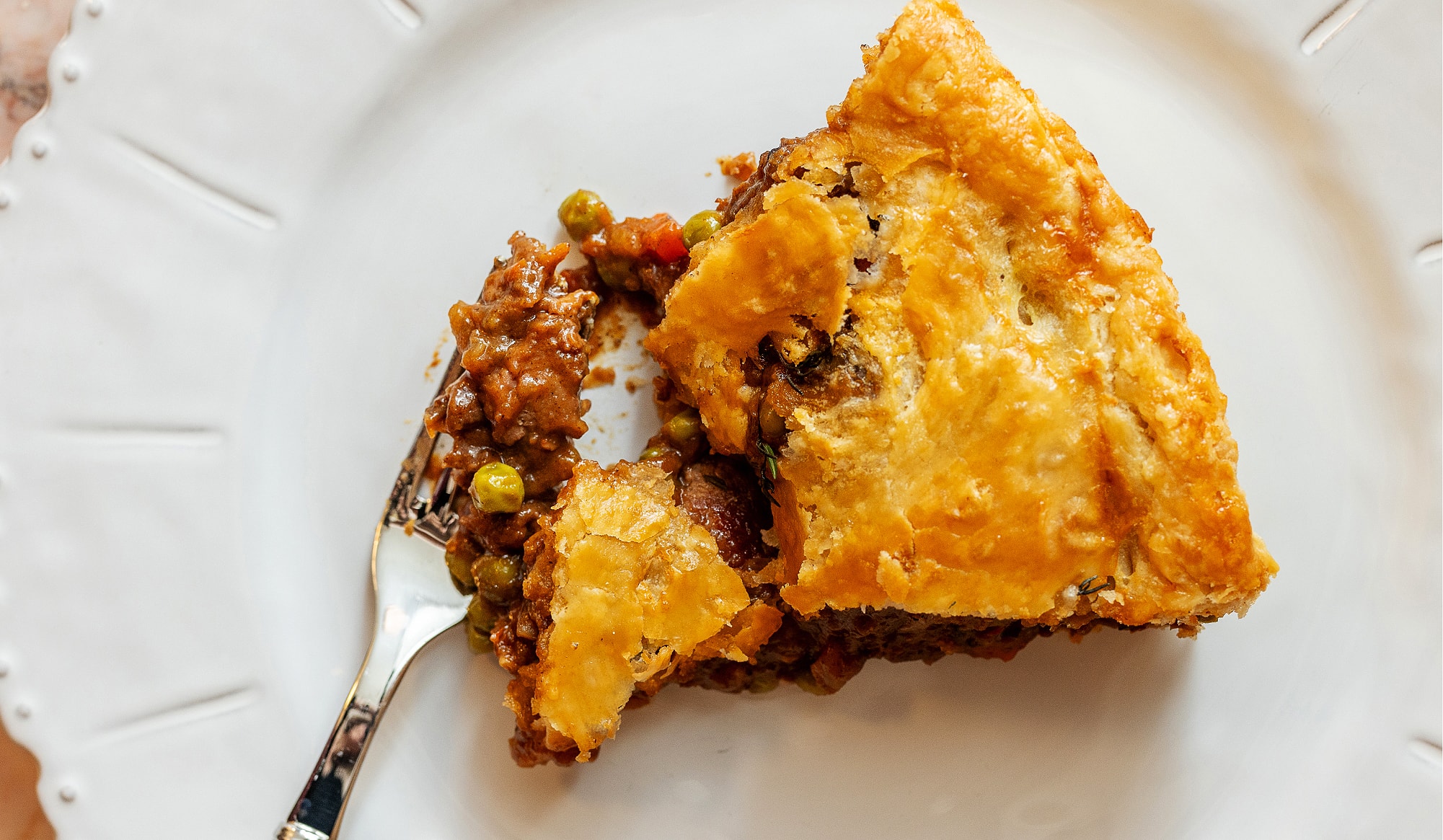
Any time I make beef stew, I make it with future me in mind. Not in a lofty, self-improvement way. In a very practical, Tuesday-night, please do not make me start dinner from scratch sort of way.
This leftover beef stew pot pie is my favorite kind of second dinner: you already did the hard work. Now we just tighten up the gravy so the pie actually slices cleanly, tuck everything into a bottom crust, and cap it with a golden top crust that shatters at the fork. Cozy, a little nostalgic, and honestly easier than it looks.

In this recipe, I am assuming your stew is already cooked and seasoned. All we are doing is adjusting the thickness if needed (if it looks a little brothy once warmed), then baking until the filling is bubbling and the crust is deeply golden. It is the kind of leftover makeover that feels like a brand new meal.
The idea
Why This Recipe Works
- It uses a specific amount of stew. Measuring the filling prevents overflow and ensures the pie bakes through evenly.
- A quick stovetop thickening step fixes loose gravy. A little flour slurry (or cornstarch) turns soupy stew into a sliceable pot pie filling.
- Blind baking the bottom crust keeps it crisp. A short pre bake sets the crust so it does not soak up gravy and go gummy.
- Vents plus an egg wash give the best top crust. Steam escapes, the filling bubbles properly, and the crust turns glossy and golden.
Shopping
Ingredient Notes
- Leftover beef stew: This recipe is designed for 5 cups of stew. If your stew has very large potato chunks, consider cutting them a bit smaller so the pie slices more neatly.
- Pie crust: Use your favorite double crust (homemade or refrigerated). If using refrigerated crust, let it sit at room temperature 10 to 15 minutes so it unrolls without cracking.
- Flour or cornstarch: Flour makes a classic, slightly creamy gravy. Cornstarch makes a glossy gravy and thickens fast. Either works. Use one or the other, not both.
- Broth: Optional, but helpful if you thicken and the filling becomes too thick. Beef broth is ideal, but chicken broth works in a pinch.
- Egg wash: One egg plus a splash of water gives you that bakery style sheen. If you do not do egg, brush with cream or milk for some color.
- Optional flavor boosters: A little fresh thyme, a spoonful of Dijon, or a splash of Worcestershire can perk up leftovers, especially if the stew was mild.
Get set up
Equipment You Will Need
- 9 inch deep dish pie plate (recommended) or standard 9 inch pie plate
- Rimmed baking sheet (for drips)
- Saucepan (to thicken the stew)
- Whisk
- Rolling pin (if using homemade dough)
- Pie weights or dry beans and parchment (for blind baking)
Technique
Tips for Getting It Right
- Cool the stew slightly before filling the crust. Warm is fine. Piping hot can melt the butter in the dough before it hits the oven, which hurts flakiness.
- How to tell if your stew needs thickening: Scoop some into a bowl. If liquid pools quickly around the solids, thicken it. For pot pie, you want a gravy that coats and clings.
- Blind bake cue: The bottom crust should look dry and just barely starting to color at the edges before you add filling.
- Seal like you mean it: A firm crimp helps keep the filling inside where it belongs. If your kitchen is warm, chill the assembled pie 10 minutes before baking.
- Bake cue: Do not pull it when it is just golden. Pull it when you see thick bubbles coming up through the vents and the crust is deep golden brown.
- Resting is not optional. The filling needs 15 to 20 minutes to set so it does not run all over the plate.
Flexibility
Substitutes That Work
- Top crust only: Skip the bottom crust and bake the filling in a casserole dish topped with a crust round. Reduce blind baking steps and shorten bake time slightly, but still bake until bubbling.
- Puff pastry top: Use thawed puff pastry for the top only. Keep it cold, vent well, and bake until deeply browned and puffed.
- No egg wash: Brush with milk, half and half, or cream for color. Or skip brushing and expect a more matte crust.
- Gluten free thickening: Use cornstarch instead of flour to thicken the gravy.
- Gluten free crust: Use a trusted gluten free pie crust brand. Blind baking becomes even more important for texture.
Make it yours
Variations to Try
- Cheddar crust moment: Sprinkle 1/2 cup sharp cheddar over the bottom crust after blind baking, then add filling. It melts into a savory barrier.
- Herby biscuit top: Bake the thickened stew in a baking dish and top with biscuits instead of pie dough for a stew and biscuits vibe.
- Mushroom boost: If your stew was light on veg, sauté sliced mushrooms in butter until browned and stir into the thickened filling.
- Mini pot pies: Divide filling into ramekins and top with dough rounds. Watch bake time, they finish faster. Bake until bubbling and golden.
On the table
What to Serve It With
- A big green salad with a punchy vinaigrette
- Roasted broccoli or green beans with lemon and garlic
- Quick pickles or a spoonful of sauerkraut for contrast
- Applesauce or a crisp apple slaw if you love sweet savory balance
Later
Storage, Freezing and Reheating
- Refrigerate: Cover and refrigerate leftover baked pot pie for up to 4 days.
- Reheat: For best crust texture, reheat in a 350°F oven until hot in the center, about 20 to 30 minutes for a large piece. The microwave works, but the crust will soften.
- Freeze baked pot pie: Cool completely, wrap tightly, and freeze up to 2 months. Thaw overnight in the fridge, then reheat at 350°F until hot and re crisped.
- Freeze unbaked pot pie: Assemble, wrap well, and freeze up to 2 months. Bake from frozen at 400°F on a rimmed sheet until deeply golden and bubbling, usually 75 to 90 minutes. If the top browns too fast, tent with foil.
Watch out
Common Mistakes to Avoid
- Using stew that is too thin. Loose gravy turns into soup inside a pie and can make the bottom crust soggy. Thicken first.
- Skipping the baking sheet. Pot pies love to bubble over. Always bake on a rimmed sheet.
- No vents. Without steam vents, the top crust can puff unevenly and the filling may leak at the edges.
- Underbaking. A pale crust usually means the bottom is still doughy. Bake until the top is deeply golden and the filling is actively bubbling.
- Slicing too soon. Give it time to set, or the filling will run out and you will lose that perfect slice.
Questions
Frequently Asked Questions
How much leftover beef stew do I need for one 9 inch pot pie?
Plan on 5 cups of stew for a 9 inch deep dish pie plate. If you are using a standard, shallower pie plate, use 4 to 4 1/2 cups so it does not overflow.
My stew gravy is watery. How do I thicken it for pot pie?
Simmer the stew on the stove and whisk in a slurry. For flour: whisk 3 tablespoons all purpose flour with 1/3 cup cold water until smooth, then whisk into simmering stew and cook 3 to 5 minutes. For cornstarch: whisk 2 tablespoons cornstarch with 3 tablespoons cold water, whisk in, and simmer 1 to 2 minutes. You want gravy that coats a spoon and does not run like broth.
Do I have to blind bake the bottom crust?
I strongly recommend it, especially with a wet filling like stew. That quick pre bake gives you a sturdier, flakier base. If you skip it, the pie will still be tasty, but the bottom crust is more likely to be soft.
How do I vent the top crust?
Cut 4 to 6 small slits in the center, or use a small round cutter to make a few holes. The goal is to let steam escape so the filling can bubble and the crust can bake through.
What if my stew has potatoes that are already very soft?
That is totally fine. Just stir gently when thickening so you keep some chunks intact. If the potatoes are falling apart, they will naturally help thicken the filling, which is a win for pot pie.
Can I make this ahead?
Yes. You can assemble the pie, cover, and refrigerate for up to 24 hours. Bake cold from the fridge at 400°F, adding 5 to 10 minutes if needed, and bake until bubbling.
The recipe
Beef Pot Pie From Leftover Beef Stew
A cozy double-crust beef pot pie made from leftover beef stew, with an easy stovetop thickening step for sliceable gravy and simple crust vents for a perfectly golden bake.
Ingredients
- 5 cups leftover beef stew (cold or slightly warmed)
- 1 double pie crust (homemade or 2 refrigerated crust rounds), enough for bottom and top
- 3 tablespoons all purpose flour (to thicken) or 2 tablespoons cornstarch (to thicken)
- 1/3 cup cold water (if using flour) or 3 tablespoons cold water (if using cornstarch)
- 1/4 to 1/2 cup beef broth, as needed (only if filling becomes too thick)
- 1 large egg
- 1 tablespoon water (for egg wash)
- 1/4 teaspoon kosher salt (for finishing, optional)
- 1 tablespoon minced fresh thyme or parsley (optional)
Instructions
- Heat the oven and prep your pan. Place a rack in the lower third of the oven and preheat to 400°F. Set a rimmed baking sheet in the oven to preheat too. This helps the bottom crust start crisping right away and catches drips.
- Thicken the stew if needed. Pour 5 cups leftover beef stew into a saucepan and bring to a gentle simmer over medium heat. If the gravy already coats the back of a spoon and clings to the meat and veggies, you can skip to the next step.
- Flour option: In a small bowl, whisk 3 tablespoons flour with 1/3 cup cold water until smooth. Whisk it into the simmering stew and cook 3 to 5 minutes, stirring, until thickened.
- Cornstarch option: In a small bowl, whisk 2 tablespoons cornstarch with 3 tablespoons cold water until smooth. Whisk it into the simmering stew and cook 1 to 2 minutes until glossy and thick.
- Blind bake the bottom crust. Roll out the bottom crust and fit it into a 9 inch deep dish pie plate, letting excess hang over the edge. Line the crust with parchment and fill with pie weights or dry beans. Bake at 400°F for 12 minutes. Carefully remove the parchment and weights, then bake 5 more minutes until the bottom looks dry and the edges are just starting to turn light golden.
- Fill. Spoon the thickened stew into the warm par baked crust. If using, sprinkle in fresh thyme or parsley. You should have the filling mounded slightly but not overflowing. If your pie plate is shallow, you may not need all 5 cups.
- Add the top crust and seal. Lay the top crust over the filling. Trim excess dough to about a 3/4 inch overhang. Fold the overhang under itself and crimp firmly to seal.
- Vent and egg wash. Cut 4 to 6 small slits in the center of the top crust for vents. Whisk 1 egg with 1 tablespoon water, then brush evenly over the top crust. If desired, sprinkle lightly with kosher salt.
- Bake until deeply golden and bubbling. Place the pie on the preheated rimmed baking sheet. Bake at 400°F for 40 to 45 minutes, until the crust is deep golden brown and you see thick bubbles coming up through the vents. If the top is browning too quickly, tent loosely with foil for the last 10 to 15 minutes.
- Rest, then slice. Let the pot pie rest for 15 to 20 minutes before slicing. This helps the filling set so it serves cleanly.
Recipe notes
- Best pie plate for this: A deep dish plate is ideal for 5 cups of stew. If you have a standard pie plate, start with 4 cups and add only if it fits comfortably.
- Doneness cue matters more than the minute mark: Look for a deeply golden crust and bubbling filling through the vents. Bubbling is your signal that the filling is hot all the way through.
- Make it extra cozy: Stir 1 teaspoon Dijon or 1 teaspoon Worcestershire into the stew while warming it, especially if your leftovers taste a little flat.